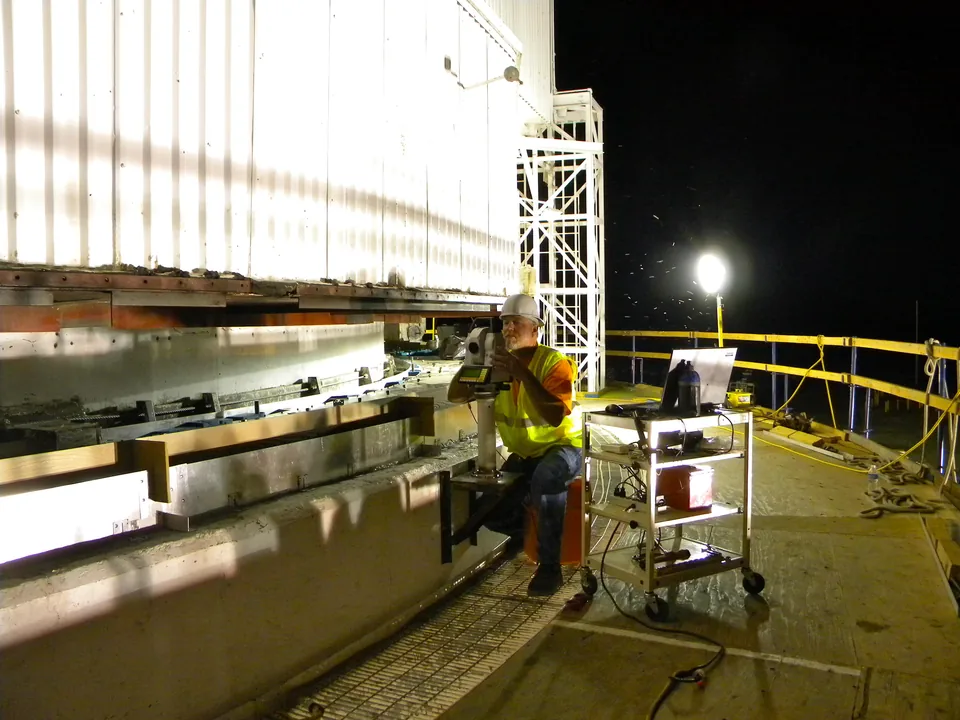
In July 2010, Tim Sink worked at night near the base of a 70-metre antenna in Goldstone, California. The Jet Propulsion Laboratory engineer was checking whether the support plates were level. The work took place after dark to keep the heat of the Sun from temporarily deforming the metal. Listening to distant spacecraft also meant looking after the surface on which the antenna turned.
An app on a phone rests on another set of supports. There is power, storage, connectivity and the work of third-party services. If a single indispensable part stops responding, what a person can do may change. Guaranteeing the absence of any failure would require control over conditions that no system can command entirely.
What remains when one part fails
In November 2023, Voyager 1 was still transmitting a signal Earth could receive. The data carried on it had become unusable. In April 2024, the team restored engineering telemetry by rearranging code in the memory that still worked. In June, JPL confirmed that all four instruments were returning usable science data again.
The distance made it impossible to replace the component physically. A communication link that still accepted commands and memory that could be reprogrammed gave the team a way to recover. That suggests a useful question for an app team. If the part that fails is the one we need to diagnose and repair the problem, what alternative access remains?
A message can wait for another connection
In space communications, NASA studies networks in which an intermediate point stores information until it can pass it to another. The Bundle Protocol standardised by the IETF describes how to carry units of data along a path that can tolerate disruptions. A message can move in stages if the system can keep it and find a connection in time.
On a phone, saving a message locally and confirming its arrival are different states. An acknowledgement that it was saved can be immediate. Delivery requires a working path to the recipient and reliable evidence of what arrived. An interface that shows where the message stopped helps readers decide whether to wait or try another route.
When recovery also puts pressure on the network
A failed operation can be retried at several points in a system. If they all retry quickly, the workload rises precisely when less capacity is available. Google’s site reliability engineering handbook describes how overload spreads between services and discusses request limits, progressive backoff and controlled degradation.
Redundancy depends on the paths being independent. Two instances that call the same unavailable service can fail together. During an interruption, it makes sense to preserve essential operations and let others wait. Decide what counts as essential before the incident, then measure it in a trial that deliberately removes the primary dependency.
Sources in this section 5
What we can promise
The Goldstone photograph shows the margin of reliability built through everyday work. For a digital service, it can come from a bounded queue, a local record that survives a restart, a backup connection or diagnostics that remain accessible when the rest is unavailable.
Measuring how long recovery takes, which data survive and which functions people can still reach turns a vague promise into testable questions. Engineering can reduce the chance of failure, contain its consequences and prepare for recovery. The answers still depend on the conditions in which the system operates.
Sources and references
- JPL · Restoring engineering telemetry and repairing Voyager 1 memory
- JPL · All four science instruments resume operations, June 2024
- NASA · Delay and disruption tolerant networking
- IETF · RFC 9171, Bundle Protocol Version 7
- Google SRE · Addressing Cascading Failures
- JPL · Goldstone photographic archive, 8 July 2010
Sources reviewed on .