Imagine two installers for the same version. They open the same menus and appear to behave in the same way. Their SHA-256 checksums differ. The difference might come from an embedded date, file order, a tool or a different component. Before deciding whether there is a problem, we need to know what we are comparing.
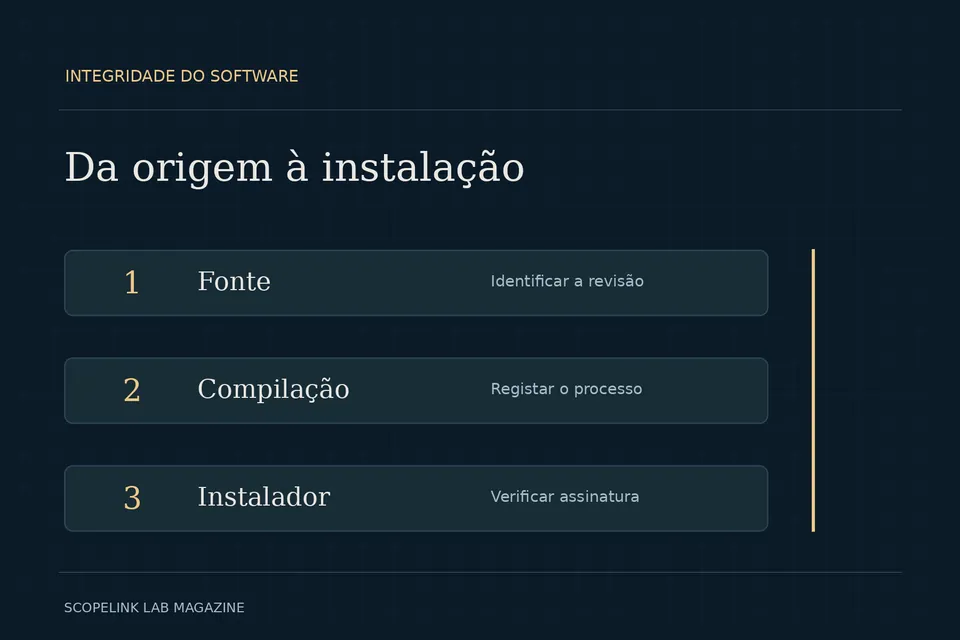
In F-Droid, independently reproducible builds help connect an APK to its source code and documented build. Using the app, examining the contents of its package and identifying its signer provide distinct pieces of evidence.
Signer identity and integrity
A SHA-256 hash can compare the bytes of an artefact against a value obtained through a trusted channel. If the file and its list of hashes are replaced together, a match alone no longer answers the question of origin.
A verifiable signature protects integrity and binds the package to a key. We still need to know whose key it is and whether it is the one expected for distribution or an update. In Android, signatures are part of an app’s identity. Two functionally equivalent builds can be packaged differently and yield different hashes.
Repeat the build and account for differences
Reproducing a build means obtaining the same bytes from its declared inputs and relevant conditions. This can require pinning the compiler, dependencies, ZIP file order and metadata. In some Android workflows, F-Droid checks the build against the package signed by the project by copying the public signature data. The private key stays with its holder.
Gradle dependency locking helps resolve the same set of dependencies again. Dependency verification checks hashes and, where configured, signatures. A lockfile tells us which version was selected. Verification tells us whether the bytes match what was previously approved.
What we can ask of a component list
A software bill of materials, or SBOM, inventories components and dependencies. Provenance adds information about who produced the file and how. Questions about an update can begin with the expected signature, continue through the inventory and end with an independent rebuild when one is available.
A verified installer still needs functional and security assessment. These mechanisms help us ask better questions about its origin. A claim of full reproducibility requires evidence for the specific artefact.
| Evidence | Question |
|---|---|
| SHA-256 | Do these bytes match the reference file? |
| Signature | Did the expected key sign this package? |
| Provenance | What process was used, and which inputs did it declare? |
| Reproducible build | Can someone repeating the build obtain the same bytes? |
Sources and references
- F-Droid · Verifying reproducible builds
- Gradle · Dependency locking
- Gradle · Dependency verification
- Ecma International · CycloneDX inventory, ECMA-424
- SLSA · Artefact provenance
Sources reviewed on .