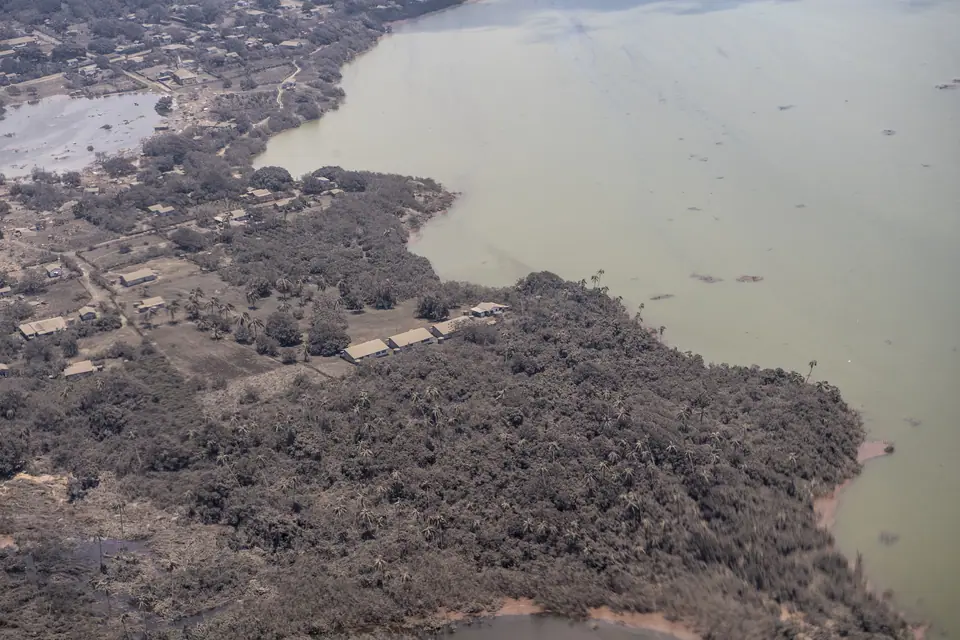
On 21 January 2022, Tonga’s National Emergency Operations Centre recorded its first update from the Ongo Niuas island groups since the eruption six days earlier. Some connections were returning intermittently. The official bulletin described Niuatoputapu residents who had received a warning from relatives and moved to higher ground. Being able to communicate could make the difference between receiving a warning and waiting for news.
Tonga restored its international fibre connection in just over five weeks. Repairs to the cable serving Ha’apai and Vava’u took about 18 months. Between those two dates, “Is Tonga connected again?” always called for another question. Which service was back, and for whom?
Recovery timeline
-
The main phase of the eruption begins
The Hunga eruption enters its main phase. It produces an atmospheric pressure wave and tsunamis observed across the Pacific. Source
-
Transmission over the cables stops
The domestic cable stops transmitting first. Transmission over the international cable is lost one hour and 14 minutes later. Source
-
First update from Ongo Niuas
The national operations centre records the first update from the Ongo Niuas island groups since the disaster. Source
-
The meteorological service resumes international contact
The International Tsunami Information Center reaches the Tonga Meteorological Service by satellite phone. Source
-
Three portable data terminals
The ETC records three BGAN terminals supporting the government and humanitarian response in Vava’u and Nuku’alofa. Source
-
The international cable returns to service
Repairs to the Fiji link allow services in Tongatapu to resume as reported. The domestic fibre link remains affected. Source
-
Operations centres gain satellite internet
The ETC and the government install VSAT data terminals at the operations centres in Vava’u and Ha’apai, respectively. Source
-
The domestic cable returns to service
Repairs restore the fibre linking Tongatapu to Ha’apai and Vava’u. Operators can shift traffic back to the cable. Source
Two routes, two breaks
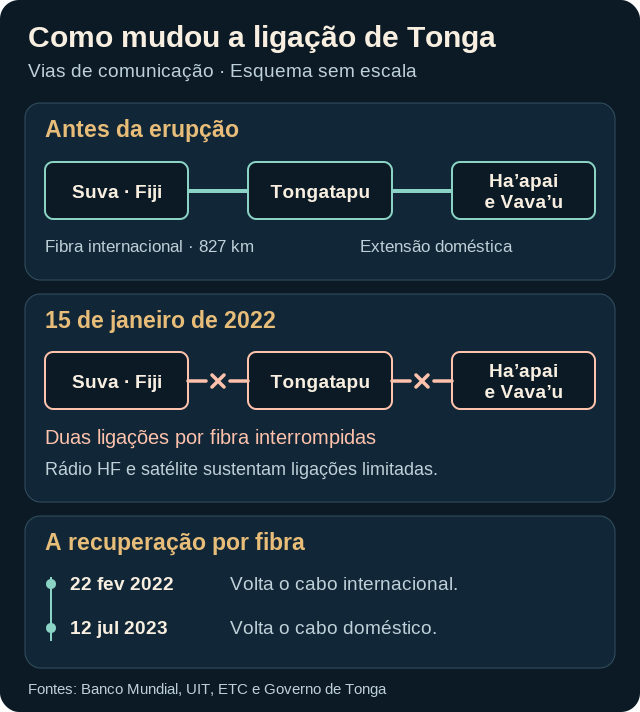
Before the eruption, the international fibre connection ran from Nuku’alofa, on the main island of Tongatapu, to Suva in Fiji, covering 827 kilometres. It opened in 2013. A domestic extension in operation since 2018 connected Tongatapu to the Ha’apai and Vava’u groups. The World Bank recorded 1,217 kilometres of cable network at the end of that project. In January 2022, the Fiji route was Tonga’s only international cable.
The main phase of the Hunga eruption began at about 16:47 local time on 15 January, according to the international team from UNESCO’s Intergovernmental Oceanographic Commission. Transmission records analysed by Michael Clare, Isobel Yeo and colleagues place the domestic cable break at 17:30 local time and the international break at 18:44. The time each route failed is known. The extent of the damage along the seabed was determined later.
What swept across the seabed
The analysis published in Science brought together the timing of the breaks, surveys of the seabed and deposits found after the eruption. As volcanic material entered the water, it formed currents denser than the surrounding water. Guided by the shape of the seabed, they travelled more than 100 kilometres. Based on the distance and time available, the authors estimated that the leading edge of one current reached up to 122 km/h. This is an estimate for the route, without direct measurements along its full length.
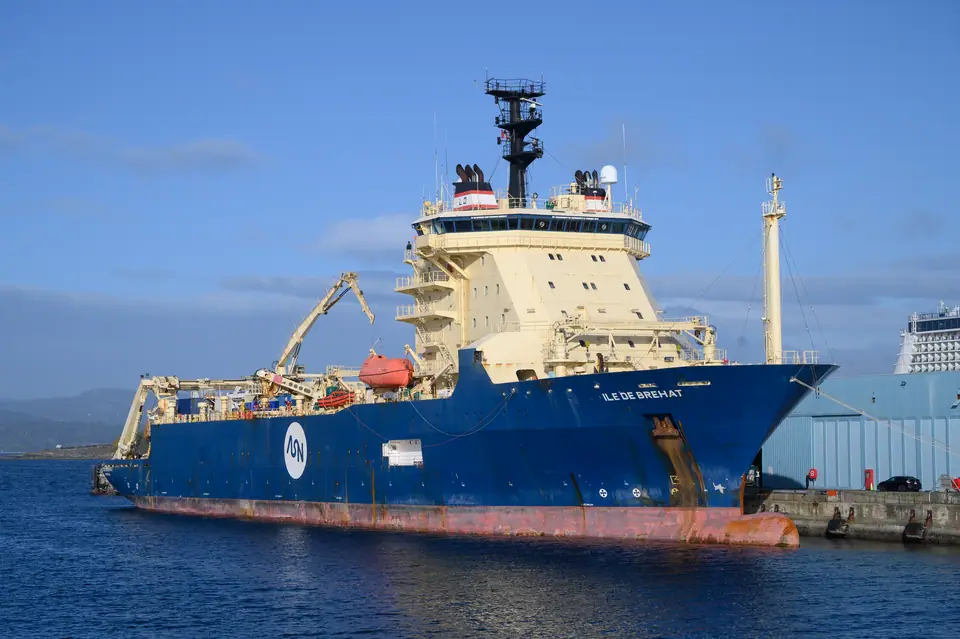
The study identified more than 89 kilometres of international cable that had broken or been buried too deeply to recover, along with 105 kilometres of affected domestic cable. Testing the fibre from land helped estimate the location of the first damage. A specialist ship had to retrieve intact ends and assess the length that needed replacement. The availability of the ship and spare cable affected how long repairs took.
A call beyond the usual network
The ITU received Tonga’s request for assistance from a satellite phone used by the ministry responsible for communications. On 25 January, ten days after the eruption, the director of the International Tsunami Information Center reached the Tonga Meteorological Service for the first time since the disaster, also by satellite phone. One call connected two workplaces. The networks many people used every day still offered limited service.
Data access took a different route. Local staff reused a terminal at the meteorological service at Fua’amotu Airport and pointed it at a satellite, with technical support and temporary capacity coordinated by the ITU. The Emergency Telecommunications Cluster, or ETC, also reported that portable data terminals were used, including in Vava’u. Operators Digicel and Tonga Communications Corporation partly restored voice, SMS and internet services using backup satellite links. The 31 January report described the networks as overloaded.
A satellite phone provides voice service to someone equipped to use it. A data terminal can provide an internet connection to a team or facility. As the operators did, a mobile network can use satellite links to connect part of its infrastructure to the rest of the network. In this setup, mobile phones still depend on the local mobile network. Each solution serves different people and locations and has its own capacity limits.
Waiting for news and supplies
Relief operations were already under way while equipment was being installed. OCHA described teams visiting areas that had initially been hard to contact, water distribution, and water tanks contaminated by ash or salt water, depending on the location. The same report documented that at least 62 people from Mango were evacuated first to Nomuka and then to Tongatapu. In an operation spanning several islands, confirming whether a community has received water or a shelter still has room can be as important as sending the initial request.
High-frequency radio, or HF, kept some links working during the isolation. The subsequent response strengthened that capability. In December 2022, the ETC and the government installed and tested a control station in Nuku’alofa. The final report records links to ‘Eua, Ha’apai and Vava’u and training for local technicians. In Ha’apai and Vava’u, satellite data connections at the operations centres also went down when a storm caused power failures. Support included uninterruptible power supplies.
The Fiji cable came back first
The international cable was restored on 22 February 2022. The ETC reported that around 90% of mobile voice, SMS and internet connectivity services were restored in Tongatapu. That percentage refers to the service restoration reported on the main island. The domestic cable remained damaged, and the outer islands depended on alternative links.
Tonga’s government and Tonga Cable confirmed that the domestic cable was restored on 12 July 2023. They attributed the interval to the type of cable that had to be manufactured, its delivery and the availability of a repair ship. The two dates mark different stages of recovery. The first restored the country’s international fibre connection. The second allowed operators to use fibre to carry traffic from Ha’apai and Vava’u again.
The next connection must be in place before failure
Tonga shows what can happen when multiple connections are exposed to the same hazard. Two cables served different functions, and both were hit on the same day. An alternative on a separate route reduces that dependency if it has its own power, enough capacity for expected demand, maintenance and people trained to put it into service.
For Horizonte 2126, the design lesson is to test each route separately and check, island by island, who can receive and reply when the main route fails. Messages can also be stored locally until a connection becomes available. That approach still requires a physical means of communication to become available later. Its use in a disaster of this scale remains a working hypothesis.
Sources and references
- IOC-UNESCO · International survey of the Tonga tsunami and contact with the national meteorological service
- Banco Mundial · Completion report on the international and domestic fibre networks
- Banco Asiático de Desenvolvimento · Tonga–Fiji cable and extension project
- Clare, Yeo e colegas · Timeline of cable breaks and submarine currents, Science, 2023
- UK Centre for Ecology & Hydrology · Open-access manuscript of the study by Clare, Yeo and colleagues
- Centro Nacional de Operações de Emergência de Tonga · Situation report, 22 January 2022
- OCHA · Humanitarian situation report, 25 January 2022
- União Internacional de Telecomunicações · Response and reuse of the satellite terminal
- Emergency Telecommunications Cluster · Situation report, 31 January 2022
- Emergency Telecommunications Cluster · Final report, April 2023
- Tonga Cable Limited · Updates on domestic cable repairs
- Governo de Tonga via PACNEWS · Confirmation that the domestic cable had been restored
Sources reviewed on .