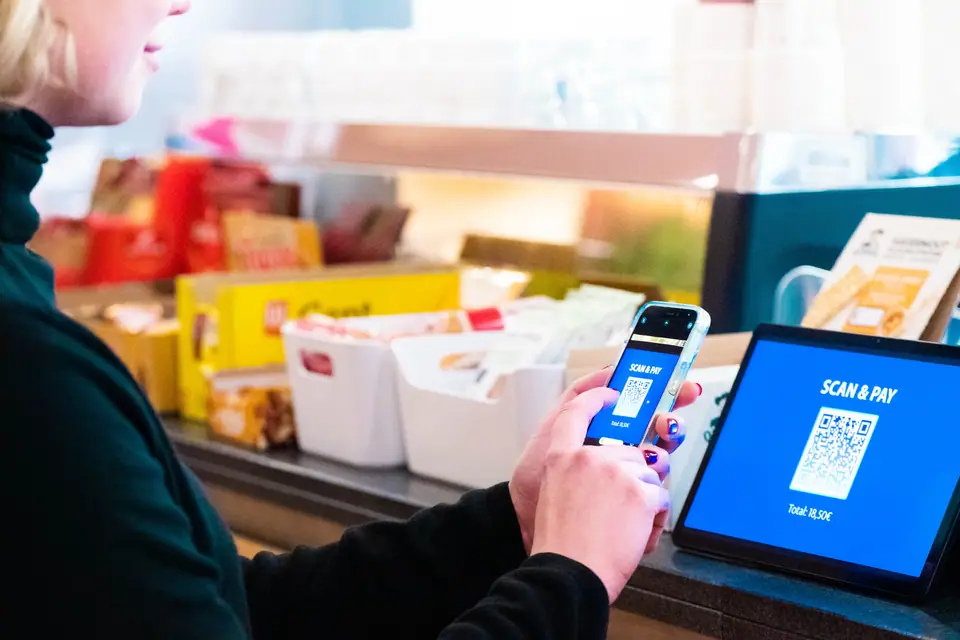
Two phones can exchange a sentence without being on the same network. One displays a QR code on its screen. The other points its camera at the code and retrieves the sentence represented by the image. When the code contains the text directly, the phone can read it without opening a link or connecting to a network.
Light carries information across the short distance between the screen and the sensor. The engineering task is to make sure the camera can distinguish the symbols and the app can interpret the recovered data.
The earlier feature “A message that travels through light” measured how individual symbols were read. This time the focus is on the move from one image to several, which introduces problems with ordering, duplicates and missing parts.
The camera looks for a pattern
The large squares in three corners of a QR code help the reader find the code and recognise its orientation. The small light and dark modules carry data and control information. The light margin around the symbol helps separate it from the rest of the image.
DENSO WAVE documents four levels of error correction. Reed–Solomon redundancy allows some data to be recovered when part of the symbol is damaged. For the same message, more redundancy can require a larger QR code. The published percentage refers to codewords and varies with the chosen level. Covering a critical part of the image can produce an effect that the percentage alone cannot predict.
When a single code becomes a sequence
A single code has limited capacity. To send more data, an app can divide the content into parts and show them one at a time. An identifier distinguishes the transfer from others in progress. Numbering lets the receiver detect duplicate parts and identify missing ones. In a simple sequence, a missing part means waiting for the next pass.
Blockchain Commons’ Uniform Resources document another design that transmits redundant parts calculated from the data. The receiver tries to reconstruct the message as soon as it has enough information. The method can tolerate the loss of some images. The decoder must understand the same format even if a general-purpose QR reader can read each symbol as text.
A short, exposed channel
Glare on the screen can hide modules, and blur can merge neighbouring squares. Greater distance reduces the number of camera pixels representing each module. If the images change too quickly, the camera may miss some stages of the sequence or capture them during a transition. A damaged camera or an unreadable screen can make the connection unusable.
To compare devices in a future test, the lab would record the size of the symbols on the screen, lighting, distance, time to obtain the complete message and the proportion of attempts that succeed. Reading a single QR code leaves open whether a long sequence works reliably.
Reading the code and trusting the content
Error correction helps recover data from the channel. Authenticity requires a separate mechanism. A digital signature can verify origin if the recipient already has a trusted reference for the public key. Authenticated encryption can protect the content and detect changes in transit when keys are managed securely.
Anyone who can see the screen can film it. An educational resource can use an entirely fictional message. A working system must first decide which information should be shared and what to do if the recipient lacks a recognised key. A screen-to-camera transfer provides a short-range alternative when both devices can see and interpret the same signal.
Sources and references
- DENSO WAVE · QR code error correction
- Blockchain Commons · Animated QR codes
- Blockchain Commons · Uniform Resources and multipart formats
- IETF · RFC 8439, authenticated encryption
- IETF · RFC 8032, EdDSA digital signatures
Sources reviewed on .